
Our work focuses on regenerating biodiversity in human-generated monocultures and landscapes built on control and hegemony. No longer fertile, many of these systems; ranchlands, fields, and managed pastures, depend on constant artificial augmentations and interventions to be productive. As the reducing availability of water becomes the predominant limiting factor in a changing climate, that model is no longer sustainable.
True restoration replaces archaic practices with the processes nature designed to evolve and adapt. By returning flow, shade, and soil life, we help ecosystems reclaim their capacity to regulate themselves. Rewilding is not nostalgia, it is the practical work of saving nature from collapse. Every project is a step toward a simple goal: a return to the wild.

Woody Creek Resources provides subcontract ecological expertise for restoration planning and implementation. Services include habitat inventories, impact assessments, restoration design, monitoring, and permitting support. I partner with consulting firms, NGOs, and public agencies to deliver science-based restoration outcomes, on time and within scope.
Woody Creek Resources provides prairie and grassland restoration services across Montana and the Northern Rockies, converting degraded rangeland and former agricultural fields back into self-sustaining native ecosystems. Fire is one of the natural processes most often missing from these landscapes, and one of the most misunderstood. As a former wildland firefighter, I was trained to extinguish fire as a threat, training that later revealed its own paradox, as many of the fires suppressed were the same ecological processes these landscapes evolved to depend on. That direct experience with fire suppression, combined with years of independent study into how nature uses fire and how indigenous peoples applied it long before modern land management, now informs how we advise clients on reintroducing fire safely and responsibly. We are not certified fire practitioners, and we are candid about that, but clients get the rare combination of someone who has fought fire and someone who understands why it belongs on the land.
Woody Creek Resources brings direct field depth in wildlife and mammal ecology across Montana and the Northern Rockies; migration patterns, trophic structure, and population dynamics informed by decades of independent field study, not desk-based modeling. Much of this work happens on private land, and that matters: state wildlife agencies are structured primarily around hunted species management, leaving most of what actually sustains a functioning ecosystem without dedicated oversight. As public land protections, staffing, and funding continue to erode, private and restored lands increasingly function as lifeboats, refuges that preserve species populations and genetic diversity in place until larger, connected systems can recover.
Plant ecology is where restoration work becomes visible and actionable, it is often the entry point for landowners who want to support wildlife but don't know where to begin. Woody Creek Resources focuses on native plant community regeneration: rebuilding the layered vegetation structure that anchors soil, retains moisture, and provides the food and cover base every trophic level above it depends on. Plants and wildlife are inseparable in practice, a corridor is only as functional as the vegetation that makes it usable, but plant restoration is the lever most landowners can pull directly, on their own land, without waiting on agency permission or funding.
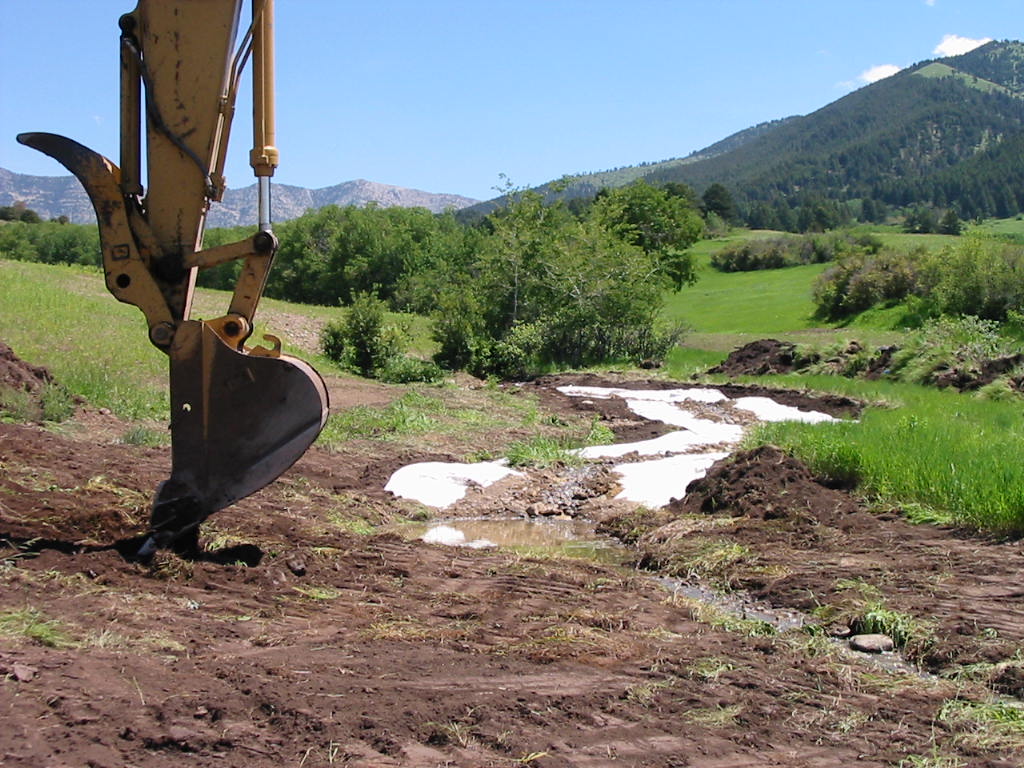
Woody Creek Resources restores the full range of aquatic systems across Montana and the Northern Rockies; wetlands, riparian corridors, streams, spring creeks, ponds, and lakes, treating each as part of one connected hydrological system rather than isolated repairs. Channel alignment and bank stabilization projects prioritize vegetative bank stabilization, deep-rooted native plant communities that hold soil and absorb energy, over rip rap and other hardened, artificial armoring. Rip rap treats the symptom, not the cause: it severs the natural interaction between a stream and its floodplain rather than restoring it, often shifting erosion problems downstream instead of resolving them.
Woody Creek Resources provides fisheries-focused restoration services for landowners, anglers, and property owners who want healthy, productive fish habitat, whether that's a private pond, a stretch of trout stream, or a cold-water fishery under pressure from changing conditions. We also account for climate change impacts on fisheries directly, warming water temperatures and reduced summer flows are already affecting cold-water species across Montana, and habitat design that ignores this trend won't hold up over time.
Not every project needs full restoration design and implementation, sometimes what's needed is rigorous, independent field investigation and a defensible written report. Woody Creek Resources provides standalone ecological investigations and species population studies for landowners, attorneys, developers, and other consulting firms who need field-verified data before making a decision. Woody Creek Resources also works as a subcontractor to other consulting firms, engineering companies, and agencies that need specialized field ecology expertise for a specific phase of a larger project.
Water rights work sits at the intersection of ecology, law, and land management. Woody Creek Resources conducts water rights investigations for landowners and land managers who need to understand what water rights actually exist on a property, how they are currently used, and what options are available for change, including converting historic irrigation rights to instream flow rights that keep water in a stream for ecological benefit rather than diversion.
Every successful restoration begins with feasibility; ecological, financial, and cultural. Woody Creek Resources helps clients identify what is possible and how to make it happen responsibly. Each project begins with a detailed Feasibility Assessment that evaluates site conditions, limiting factors such as water availability, permitting needs, and long-term sustainability.
We also assist clients in finding support through state and federal grant programs, watershed councils, and conservation partnerships. By aligning ecological goals with regional priorities, projects often qualify for cost-share programs, technical assistance, or cooperative funding.
Collaboration is central to how we work. Woody Creek Resources partners with public agencies, universities, and nonprofit organizations to ensure scientific rigor and long-term continuity. These relationships help each project grow beyond a single property into part of a larger connected effort to rewild and restore biodiversity across the Northern Rockies.
Email: woodycreek@runbox.com
Phone: (406) 930-0456 | Office: (406) 932-7028
Base: Big Timber, Montana • Projects across the Northern Rockies